
Impact assessment
Human impacts on wildlife
Human activities can affect animals and their natural environments in many ways. These effects can come from, e.g.:
- Chemical pollution – such as an oil spill.
- Physical barriers – like buildings or underwater structures.
- Noise – for example, pile driving during marine renewable energy projects.
- Direct harm – such as animals being struck by vessels or turbine blades.
- Climate change – through changes to the environment.
All these factors are known as stressors or pressures, because they have the potential to affect animals and their populations, positively or negatively.
Stressors can influence animals in several ways. They might:
- Change how animals behave.
- Affect where they spend their time.
- Impact their health, survival, or ability to reproduce.
Types of Impact Assessments
There are two main types of impact assessments:
- Prospective assessments – carried out before an activity takes place to predict possible effects. These are often required by law to help regulate human activities.
- Retrospective assessments – carried out during or after an activity to determine whether impacts have occurred. This could include routine monitoring (for example, around wind farm construction) or responses to unexpected events like oil spills.
What Information Is Needed
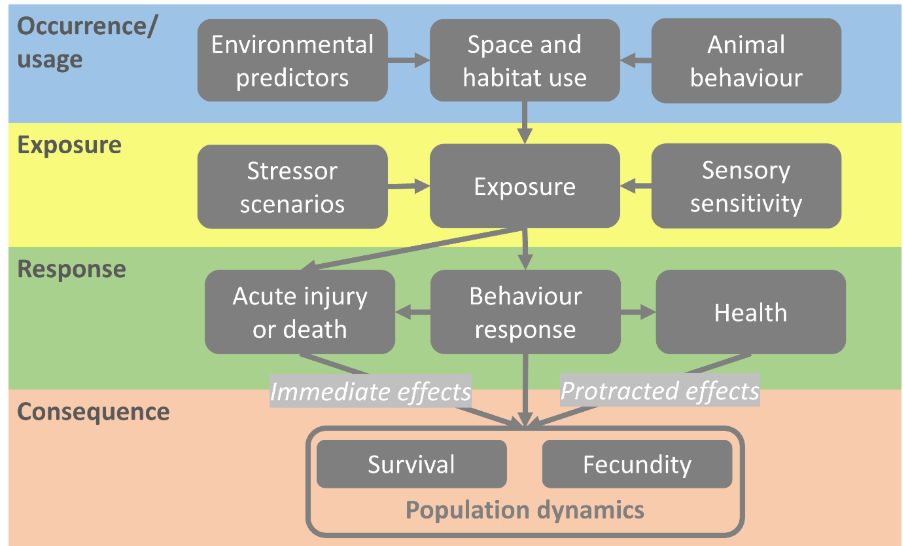
To understand and assess impacts, we need to know:
- Occurrence & Usage: When and where animals are found, their population density at a given location, and what they are doing there
- Exposure: How many individuals are likely to be exposed to the stressor, how often and for how long
- Response: Whether and how individuals respond to, or are directly affected by, the exposure
- Consequences: How responses affect population dynamics
Click on the links below for details of CREEM research in each of these areas.