
Causal Inference
What is causal inference?
Causal inference is a group of methods that investigate relationships of cause and effect rather than correlation/association. Ecologists regularly ask questions about cause and effect in natural systems and are regularly called upon by funding and governmental bodies to help find causal links in service of evidence-informed policymaking. Historically, the only acceptable method by which to make conclusions that some treatment caused, rather than was just associated with, some effect was by running a randomized, controlled experiment. Alongside experimental methods, causal inference has evolved into a language for the analysis and identification of cause-and-effect relationships in observational settings.
What has CREEM contributed?
CREEM research in this area is focussed on reducing barriers to the use of causal inference methods in ecological and environmental modelling. This includes extending methods for causal discovery, or the estimation of the structure rather than strength of causal relationships, to the kinds of spatiotemporal observational data common to ecological and environmental studies. CREEM has also been involved in the design of experiments to determine drivers and effects of changes in biodiversity .
What species are these methods used for?
Observational causal inference methods are appropriate for all species and taxa where observational data are available. In principle, biodiversity experimental design methods apply to any species, but in practice they are limited to species and situations in which the experimenter can set or control the design variables of intere
Who in CREEM works on these methods?
- Ben Swallow
- Hannah Worthington
- Rosemary Bailey – Emeritus Professor
PhD Students: Rebecca Supple
A few relevant and recent publications by CREEM staff
Swallow, B. (2025). Seconder of the vote of thanks to Cork et al. and contribution to the Discussion of ‘Methods for estimating the exposure–response curve to inform the new safety standards for fine particulate matter’ by Cork et al., Journal of the Royal Statistical Society Series A: Statistics in Society, Volume 188, Issue 4, October 2025, Pages 986–988,
Supple, R.F., Worthington, H. and Swallow, B. (2026). Discovering causal relationships between time series with spatial structure. Statistical Science (Under Review) (ArXiv Preprint)
Emery, K.A., Dugan, J.E., Bailey R.A. and Miller, R.J. (2021). Species identity drives ecosystem function in a subsidy-dependent coastal system. Oecologia, 196, 1195–1206.
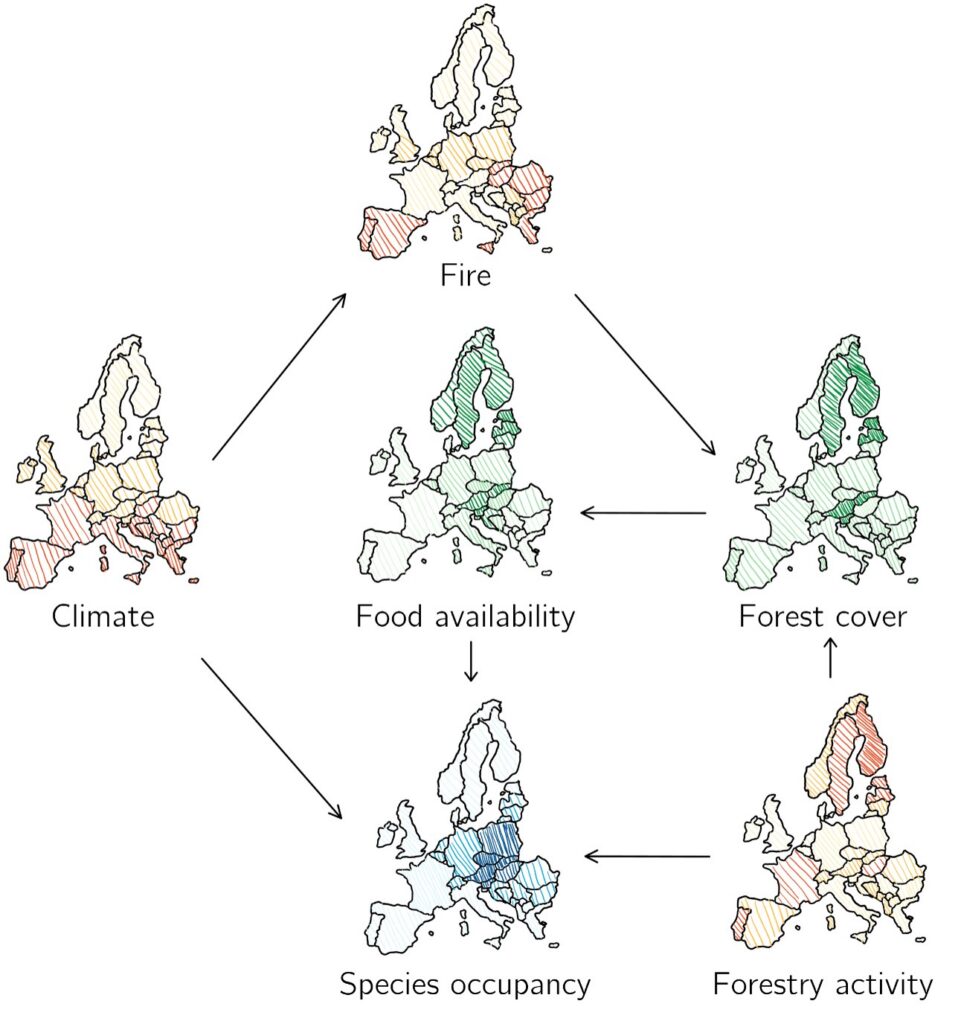
Caption: Illustration of a causal graph in which causes are connected to their direct effects by arrows. In this hypothetical system, changes in climate affect a species’ occupancy across Europe both directly and indirectly via changes in fire prevalence, forest cover, and food availability. Anthropogenic forestry activity also has direct and indirect effects on species occupancy. We can use this graph to, for example, identify models of causal effects or forecast under interventions. Causal discovery methods help us estimate the structure of these graphs from data.